Escape Room Alternatives You Can Do at Home
Everything an escape room gives you — a clock, a locked problem, a team pulling together — without the booking fee. Kits, puzzle boxes, apps and detective cases.
Escape rooms are excellent and they are also expensive, bookable weeks out, and finished in an hour. Wanting the same feeling on a wet Tuesday without leaving the house is an entirely reasonable thing to want.
The trick to replacing one is understanding what you are actually replacing. It is not the padlocks.
What an escape room is really made of
- A visible clock. The countdown does most of the emotional work. Without it, the same puzzles are just puzzles.
- A single shared goal. Everyone in the room wants exactly the same thing, which is rarer in social activities than you would think.
- Parallel work. Three things can be solved at once, so nobody stands around watching.
- Tactile discovery. Opening things. Finding things behind things.
- A clean win or loss. The evening resolves.
Any at-home alternative that covers four of those five will feel like an escape room. One that covers two will feel like homework.
Print-and-play kits
The closest direct substitute. You buy a PDF, print it, and work through a sealed sequence of puzzles at a table. Good ones handle the parallel-work problem by giving you several puzzles at once rather than a strict chain.
Strengths: tactile, genuinely team-based, and you can set your own clock with a phone timer. Weaknesses: printing is a chore, and they are strictly single-use.
Puzzle boxes and mystery subscriptions
Physical boxes posted to you, sometimes as a monthly series with an overarching plot. These are the best at tactile discovery, because the objects are real, and the worst at time pressure, because nothing stops you putting the box down for a fortnight. If your group needs the clock, set one yourselves and be strict about it.
App-led home escape games
A middle path: an app supplies the story, the timer and the hint system, while you supply objects around your own house. The better ones have you hunting for things in your own kitchen, which is a surprisingly effective use of a familiar space. Quality varies a great deal, so check whether the app expects a specific object you may not own before you start.
Investigation games as the closest cousin
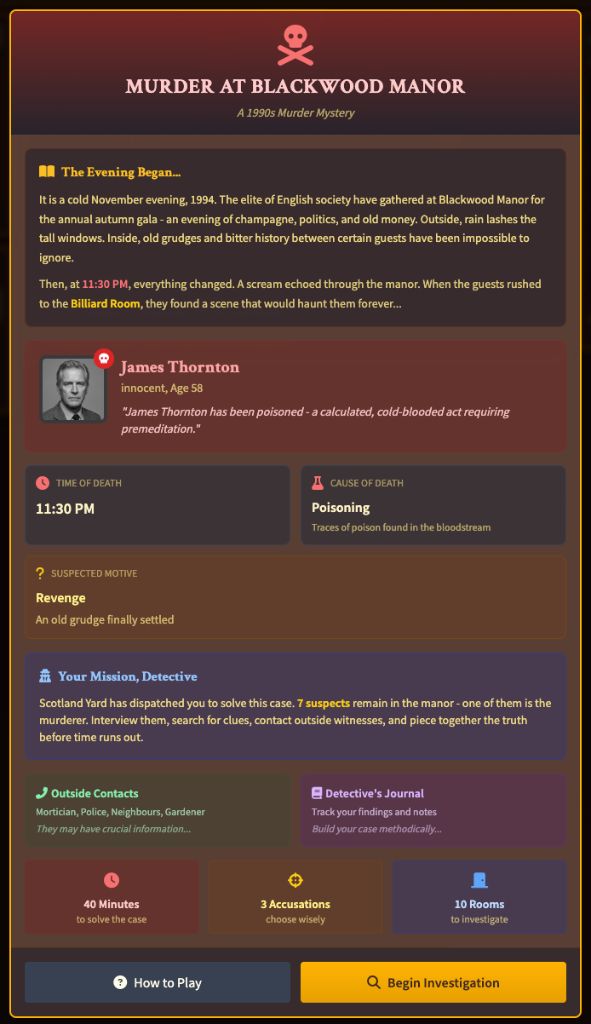
A timed murder investigation hits four of the five criteria squarely: a clock, one shared goal, plenty to do in parallel, and an unambiguous win or loss. What it trades away is the tactile element. You are searching rooms on a screen rather than opening drawers.
What you get in exchange is the thing escape rooms cannot do at all: people who answer back. An escape room puzzle does not lie to you, but a suspect will.
Our full-length investigations are built on an explicit clock, and the difficulty settings are really countdown settings. Rookie gives you sixty minutes and three guesses. Detective gives you forty minutes and two. Master gives you twenty-five minutes and a single guess, which is about as close to escape-room pressure as we can reasonably make it. There is more on how those tiers differ in our breakdown of the difficulty modes.
For a group, one person shares the screen and everybody else investigates out loud. Rotate whoever is typing so it stays a team activity. If you would rather warm up first, the Daily Case takes about twelve minutes and needs no account at all, which makes it a good way to find out whether your group has the appetite before anyone commits an evening.
Building your own
Homemade escape rooms are more work than people expect and more rewarding than they expect too. If you attempt one, the two rules that matter most are: never make a puzzle whose answer is inside another puzzle you have not opened yet, and always write down your own solutions somewhere the players cannot find them. Hosts forgetting their own combination is a real and recurring tragedy.
Three to five puzzles is plenty for an hour. Ambition is what kills homemade rooms.
Which to pick
- Four to six people, one table, one evening: a print-and-play kit.
- Two people, no printer, right now: an investigation case with the timer on.
- A gift, or something to look forward to: a puzzle box subscription.
- Kids or mixed ages: an app-led hunt around your own house.
- A group spread across the country: see our notes on mystery games over video call.
The clock is the point. Start it.