Games Like Cluedo You Can Play Online
Cluedo taught a generation how deduction feels. Here is what to play when you want that feeling online, from grid logic to suspects who answer back and lie.
Cluedo is the reason a great many people know what deduction feels like. Devised by Anthony Pratt in Birmingham during the Second World War, patented in 1947 and published by Waddingtons in 1949, it has outlived most of its contemporaries for one very good reason: the core loop is close to perfect.
If you are looking for something like it online, the useful step is to work out which part of Cluedo you want back. People miss quite different things about it.
What Cluedo actually does well
- The three-part solution. Person, weapon, room. Three axes rather than one, so partial knowledge is still progress.
- Elimination, not intuition. The grid is the game. You are not guessing who looks guilty; you are proving who cannot be.
- Information as currency. Every suggestion you make teaches the other players something. Learning costs you something, which is a lovely piece of design.
- Everyone understands it in ninety seconds. Rarely appreciated and enormously valuable.
The corresponding weakness is that there are no actual characters. Professor Plum has no personality, no motive and nothing to say. The murder is a logic problem wearing a dinner jacket.
If you want Cluedo itself
Officially licensed digital versions of Cluedo have existed for years across various platforms, and they let you play the classic game against friends or the computer. If what you miss is specifically the grid and the accusation, this is the shortest path and there is no need to be clever about it.
If you want the elimination grid
The pleasure of ruling things out is available in abundance online. Logic grid puzzles are the purest version and there are thousands of them, free, in every browser. Deduction video games such as The Case of the Golden Idol take the same skeleton and add a narrative reconstruction on top — you determine names, actions and motives from static scenes, which is Cluedo's "person, weapon, room" structure with far more meat on it.
Board games have gone a long way down this road too. Case-file games and deduction titles with a hidden traitor both descend fairly directly from Pratt's design, and several have digital implementations.
If you want the suspects to be real people
This is the gap that stayed open for decades. Cluedo gives you a murderer with no voice. Detective fiction, which Cluedo was imitating, is almost entirely about what suspects say and how they say it.
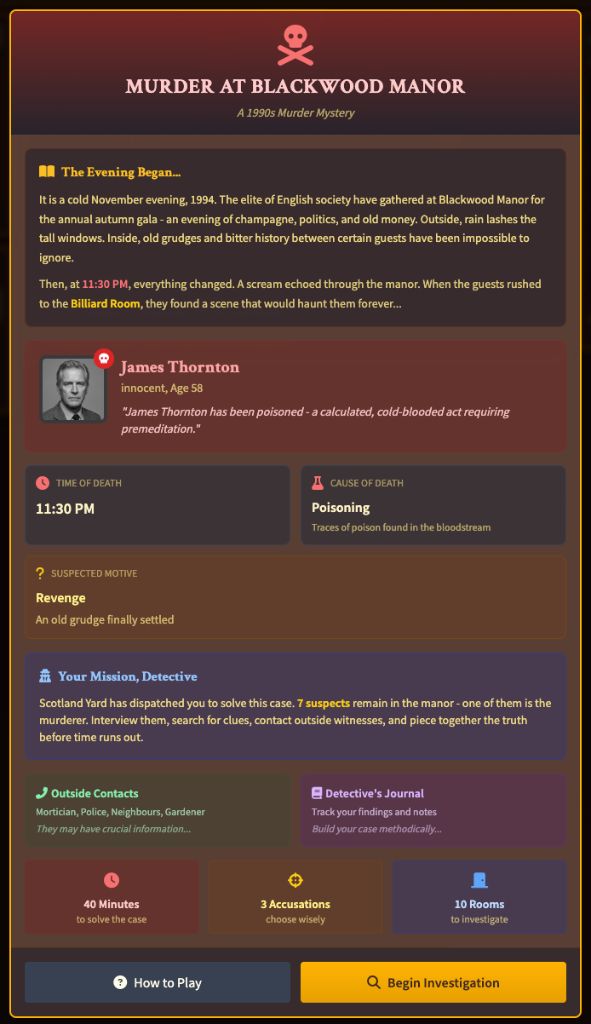
That is the gap BACKSTABBERS was built for. The structure will feel familiar: a closed setting, a body, a cast of suspects, and a solution consisting of a person and a weapon. What is different is that you find things out by asking rather than by drawing cards.
You type any question you like and the suspects answer in character. The murderer lies to you. The innocent ones tell the truth, but they all have secrets they would rather keep, so they hedge and deflect and misdirect for reasons that have nothing to do with the murder. Sorting a guilty lie from an embarrassed one is the actual skill.
And when you find a piece of evidence that genuinely contradicts something you have been told, you present it, and they crack. That is the moment Cluedo never had — the confrontation.
What we kept and what we changed
Kept: the closed circle, the named rooms you move between, the tension between wanting to accuse and needing to be certain, and a solution with more than one part. You must name the murderer and the murder weapon to win.
Changed: the room is no longer part of the answer; instead it is where you search for the eighteen clues in each setting. There are eight suspects rather than six, and ten or eleven rooms rather than nine. The elimination grid is replaced by a timeline you build yourself out of what people tell you, and the deduction is about conflicting accounts rather than dealt cards.
Two settings are available: Blackwood Manor, a 1990s English country house that will feel like coming home to any Cluedo player, and Murder on the Titanic, set in 1912.
Where to start
The Daily Case is the quickest way to see whether the format lands for you: about twelve minutes, no account, no card, and the same case as every other player in the world that day. If it does land, the full-length investigations run from twenty-five to sixty minutes depending on difficulty, and the pricing page sets out what is free and what is not.
New to interrogation as a mechanic? Our guide to deduction is the fastest way to stop guessing and start proving, and our wider genre guide covers the alternatives honestly.
The candlestick. The library. But this time, someone is lying about it.