Murder Mystery Games to Play Over a Video Call
Long-distance game night, solved. The mystery formats that genuinely survive Zoom or Discord, what to prepare beforehand, and how to keep everyone involved.
Video calls are good at some things and terrible at others. They are excellent for one person presenting to a group. They are dreadful for six people talking at once, for reading a room, and for anything that depends on physical props being passed around a table.
That single fact decides which murder mystery formats work over a call and which collapse into fifteen minutes of "sorry, you go" before someone quietly leaves.
Why the traditional party kit struggles online
A printed murder mystery kit assumes private side conversations. Two characters slip into the kitchen and trade secrets while everyone else is distracted. That whispered layer is most of the fun, and a single video call has nowhere to put it. Breakout rooms technically exist, but shuttling eight people in and out of them kills the pace stone dead.
Kits also assume everyone has read their character notes. Over a call, with a browser full of other tabs, roughly half your guests will not have. In a living room you can see that happening and steer around it. On a call you cannot.
None of this makes kits impossible online. It just means they need a confident host and a group who genuinely want to perform. If that is not your friends, pick a different format rather than fighting it.
Format one: the shared-screen investigation
This is the format that works best, and it works because it plays to what video calls are actually good at.
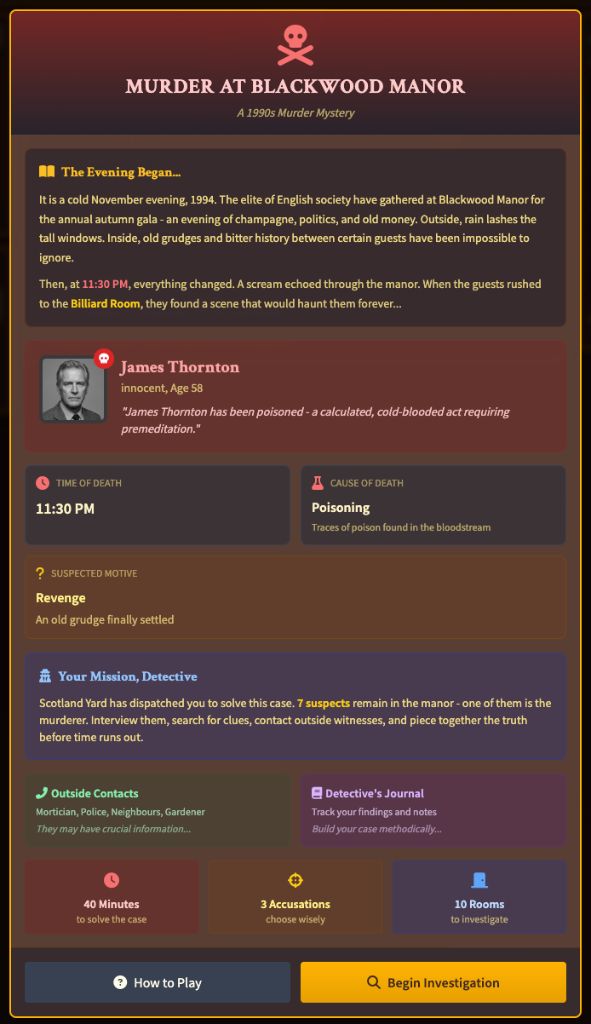
One person shares their screen and runs an investigation game. Everyone else watches, argues, and directs. The person at the keyboard is not the detective; they are the typist. The group is the detective.
It works because there is one focal point, everyone sees the same evidence at the same time, and the natural rhythm of the game creates turn-taking for free. Somebody suggests a question. Somebody else objects. You ask it anyway. The suspect gives an answer nobody expected. That is a conversation a video call can hold.
Practical rules that make it much better:
- Rotate the keyboard. Swap the screen-sharer after each suspect interview. It stops one person quietly playing a single-player game at everyone else.
- Appoint a note-taker who is not the typist. They keep a running timeline in a shared document. This is the job that makes a group better than an individual.
- Ban solving out loud too early. Agree that nobody names a suspect until you are two-thirds through the clock. Otherwise the first confident person anchors the whole group.
- Use the chat. Ask people to drop question suggestions into the call chat rather than interrupting. It solves the crosstalk problem completely.
Format two: everyone plays the same case separately
This one is less obvious and works beautifully for groups in different time zones.
Our Daily Case is the same case for every player in the world on a given day, and it takes about twelve minutes. So everybody plays it on their own whenever suits them, then compares notes on the call.
What makes this fun is not who won. It is that six people interrogating the same eight suspects will have six different conversations, because you each chose different questions. Somebody got the gardener to admit something nobody else even thought to ask about. Somebody else wasted four minutes on a completely innocent guest. Comparing routes through an identical case is more interesting than comparing scores, and it needs no scheduling at all.
No account is required, so there is nothing for anyone to sign up to before Thursday night.
Format three: social deduction
Werewolf, Mafia, Among Us and the many party-pack variants were more or less designed for this. Short rounds, one speaker at a time by rule, and elimination that gives the call a natural shape. If your group is large, loud and does not want to think especially hard, this is the correct answer and you should stop reading.
Just be clear with yourself that it is a bluffing game, not a detective game. Nobody examines any evidence. If someone in the group wanted to be Poirot for an evening, they will leave unsatisfied.
A kit list for the host
- A shared document for the timeline, opened before the call starts, not during.
- A decision on who shares first and in what order you rotate.
- An agreed finish time. Mystery nights sprawl.
- A backup format for when the first one is clearly not landing after ten minutes.
That last point matters more than any recommendation here. The failure mode of an online game night is not choosing the wrong game; it is grimly continuing with the wrong game because someone spent money on it.
If you want a longer, more serious session for a smaller group, the full-length investigations run from twenty-five to sixty minutes depending on difficulty, which is a much better fit for three or four committed people than for twelve. Our beginner guide to deduction is worth circulating beforehand if your group is new to the genre.
Different rooms. Same corpse.