Two-Player Mystery Games for a Date Night In
Mystery games that work with exactly two people: co-operative board games, deduction puzzles, and a twelve-minute case you can happily argue over on the sofa.
Two is an awkward number for mysteries. Party kits want six. Social deduction games need enough people to hide in. And most single-player detective games assume one pair of hands on the keyboard and one person having all the ideas.
Which is a shame, because two is arguably the best number for actually solving something. There is no crowd to hide behind, no one drifting off to check their phone, and every theory has to survive one sceptical listener before it goes anywhere. That is the whole appeal of the detective-and-companion structure, and it has been working since Holmes and Watson.
What actually works with two
Co-operative case-file board games. The genre that suits pairs best. You get a case booklet, a map, a list of contacts, and you work through leads together. Most play well at two because they were designed as shared-puzzle experiences rather than competitive ones. The trade-off is setup time and the fact that each case is a one-shot.
Logic and deduction puzzles. Cheap, quick, endlessly available. Two people racing the same grid puzzle is a perfectly good half hour. Not much atmosphere, though.
Single-player detective games played by two. Slightly heretical, and genuinely excellent. Games like Return of the Obra Dinn or The Case of the Golden Idol are far better with a second person, because the entire game is reasoning aloud and the second person is the one who spots what you skimmed past.
Timed investigations. A clock changes the dynamic. With two of you and a countdown, you naturally split the work rather than watching each other play.
The one-screen, two-detectives method
This is the setup we would recommend for any single-player mystery you want to share, and it takes thirty seconds to agree on.
- One types, one writes. The typist runs the interviews. The other keeps the timeline, the list of claims and the running suspect list. The note-taker is not the passenger; they are the one who will actually crack it.
- Swap after every suspect. Keeps both of you engaged and stops one person quietly taking over.
- Nobody accuses alone. Agree that you both have to say the name at the same time. The disagreements this produces are the best part of the evening.
- Argue the other side. If you both settle on the same suspect too early, one of you has to spend two minutes arguing for somebody else. It is remarkable how often that flushes out the real answer.
The competitive version
If you would rather compete than collaborate, there is a neat trick available. Our Daily Case is the same case for every player in the world on a given day. So you both play it separately, on your own devices, without talking — then compare.
Since it takes about twelve minutes, that is a twenty-five minute evening including the argument afterwards. And the argument is the good bit: two people interrogating the same eight suspects will have taken completely different routes, asked different questions, and formed different opinions of the same people. Comparing routes is more interesting than comparing results.
No account, no card, nothing to set up. It genuinely is a link and then a case.
When you want a proper evening
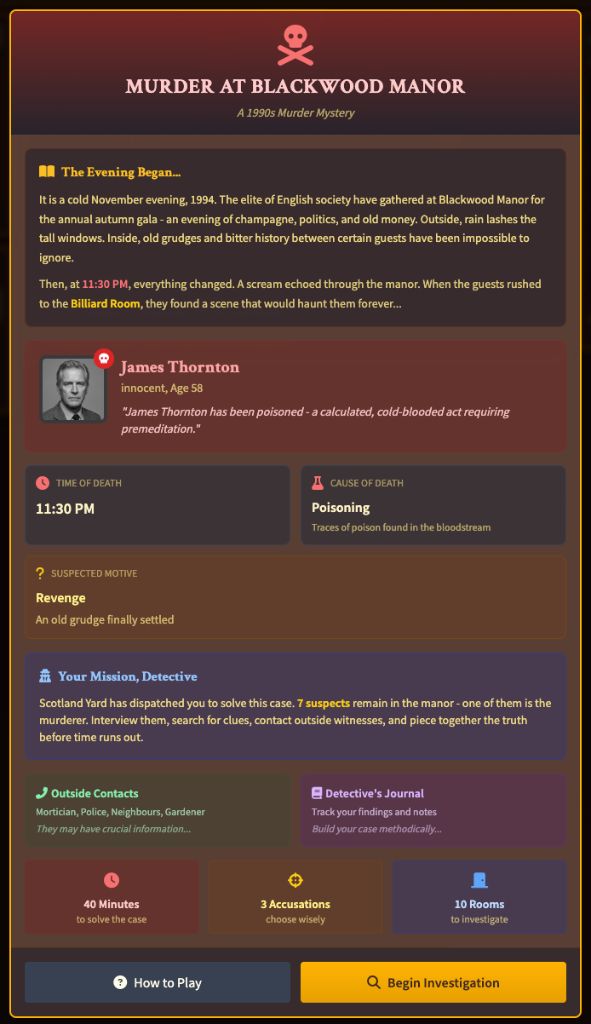
For something with more room to breathe, the full-length investigations run to sixty minutes at Rookie difficulty with three guesses to spend, which is about right for two people who want to take their time and talk it through. There are two settings to choose from: Blackwood Manor, a 1990s English country house, and Murder on the Titanic, set in 1912. Each has eight suspects, ten or eleven rooms and eighteen clues to find, so there is plenty to divide between you.
If you finish quickly and want the screws tightened, Master difficulty gives you twenty-five minutes and exactly one guess. Two people, one guess, one clock. Our notes on the difficulty tiers explain what changes at each level, and the pricing page covers what is included free and what is not.
A small piece of advice
Decide in advance what happens if you disagree at the end. Some couples enjoy a stand-off; others find it genuinely annoying at eleven o'clock at night. Agreeing beforehand that the person who found the decisive piece of evidence gets the final call saves a surprising amount of grief.
And if you are entirely new to this, our beginner guide to deduction is a decent ten-minute read for both of you beforehand. It mostly consists of telling you not to trust the shifty one.
Two detectives. One accusation. Choose carefully.