How AI Is Changing Detective Games
Dialogue trees gave you three questions to choose from. Language models let you ask anything at all. What that changes about mystery design, and what it does not.
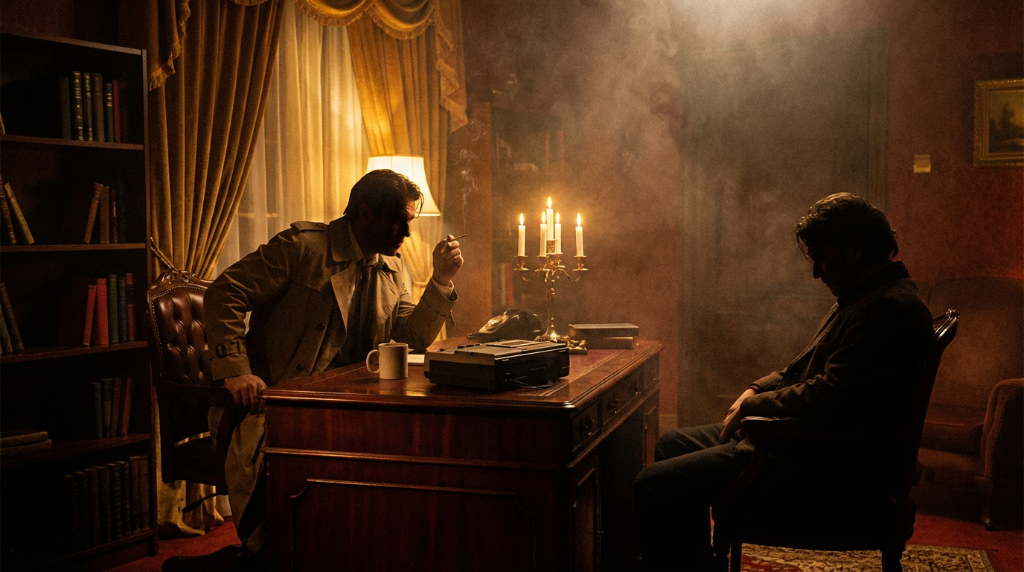
For about thirty years, interrogating a suspect in a video game meant choosing from a short list of things someone else had already written. Press up for the accusatory option, down for the sympathetic one. It worked, and some of the finest mystery games ever made were built on it. But it always had the same tell: you were not questioning a person, you were browsing a menu.
Language models change that specific thing, and it is worth being precise about what they change and what they leave exactly as difficult as it was before.
The dialogue tree problem
A branching conversation grows unmanageable at frightening speed. Three options at each of five turns is 243 leaves, all of which must be written, tested and kept consistent with the rest of the plot. Since only a fraction will ever be seen by any one player, the economics push hard towards fewer branches and shorter conversations.
The result is a game where you always feel slightly ahead of the fiction. You can see the shape of the options and therefore the shape of the author's intentions. Two of these three questions are filler; the third is the one that advances the plot.
Worse, the tree makes the wrong thing hard. In a real interrogation, the interesting move is the unexpected question — the one nobody anticipated. A tree can only offer anticipated questions by definition.
What changes when you can type anything
Give a player an open text box and something shifts psychologically before any technology gets involved. The burden moves onto them. There is no list to scan for the "right" one, so you have to actually think about what you want to know.
In our own experience building this, the effect is that players start behaving like investigators rather than like readers. They ask about things that are not mechanically important because they are curious. They circle back to something a suspect said forty questions ago. They ask a person what they think of another person, which is not a query any dialogue tree would have offered but is exactly what a real detective would do.
It also produces a lovely failure mode: asking a bad question and getting a perfectly polite, perfectly useless answer, and realising the fault was yours.
The hard part is not the talking
Here is the thing that is easy to underestimate. Making a character speak fluently is now straightforward. Making a character speak consistently, in service of a solvable puzzle, is not.
A mystery only works if there is a fixed truth underneath it. Someone did it, with something, at a particular time, and every statement any character makes has to be checkable against that truth. If the fiction drifts — if a suspect invents a detail that contradicts the actual solution — the case stops being solvable and the player's careful reasoning is silently sabotaged.
So the design work is not really conversational. It is about the layer beneath the conversation: a defined solution, a defined set of clues, and each character's own knowledge of events, which is partial and sometimes wrong for entirely innocent reasons.
Lying is harder than answering
The murderer is the difficult character to get right. A guilty suspect has to lie, and a good lie is not a random falsehood. It has to be plausible, self-consistent, and — crucially — vulnerable. A lie that cannot be disproved is not a puzzle; it is a wall.
Meanwhile the innocent suspects must tell the truth while still being interesting. Our solution is that everyone in the cast has something to hide that is not murder: a debt, an affair, a theft, a promise made to somebody else. That gives eight people eight reasons to be evasive, and means evasiveness cannot be used as a shortcut to the answer. You have to distinguish a guilty lie from an embarrassed one, which is a far better game than spotting who is nervous.
Evidence as the pressure valve
Open conversation creates one obvious risk: a player could talk in circles indefinitely and never get anywhere, because the suspect will always have something reasonable to say.
The mechanic that resolves this is evidence. When you present a suspect with a clue that genuinely contradicts what they have told you, they crack. The contradiction has to be real — it is checked against the underlying facts, not against how confident you sound. Present something irrelevant and you have simply told a possible murderer what you have found.
This is the piece that turns a conversation into a game. It gives the player an action with consequences, it rewards careful listening over persistence, and it means the case has a floor: there is always a provable path, if you find the right object and remember the right sentence.
What AI does not fix
Plenty. Pacing is still authored. The structure of a satisfying case — the false lead in the middle, the detail that means nothing until it means everything — is a craft problem that no model solves for you. Fairness is a design decision: the clues have to be findable in the time available, which is why our difficulty tiers adjust the clock and the number of guesses rather than making suspects vaguer.
And atmosphere is still writing, art and restraint. A suspect who can say anything is not automatically a suspect worth talking to.
The honest summary is that AI removed one specific constraint — the finite list of questions — and left every other hard problem in mystery design exactly where it was. That is still a significant change. It is not the whole game.
Try the difference
The quickest way to feel what an open question box does is to use one. The Daily Case takes about twelve minutes, requires no account and no card, and gives you eight suspects to ask absolutely anything. Ask something strange and see what comes back.
For longer sessions, the full-length investigations run to an hour at Rookie difficulty. If you would like to know how to use the questions well, start with our guide to deduction, or read why the shape of a detective story matters before you sit down.
Ask anything. That is rather the point.