Free Detective Games You Can Play in Your Browser
No download, no launcher, no card. What free browser detective games really offer, where the catches usually hide, and a daily case you can start in one click.
"Free detective game" is a phrase that has been stretched to breaking point. It is used for games that are free for twenty minutes, games that are free if you watch an advert between every scene, and games that are free provided you hand over an email address and then a card number to see the ending.
Here is a straightforward account of what is actually out there, what the catches usually are, and how to tell in about a minute whether something is worth your evening.
The five flavours of free
- Genuinely free, forever. Usually a small daily puzzle or a promotional taster. Limited in scope, but no strings.
- Free tier of a paid product. A real slice of the full game, with more available if you pay. Honest, as long as the boundary is stated up front.
- Free demo. The first chapter, ending on a cliffhanger by design.
- Free with adverts. Playable, but the pacing is built around interruptions, which is fatal to tension in a mystery specifically.
- "Free" requiring an account before you see anything. The email address is the price.
None of these is dishonest in itself. The problem is that search results flatten them into one word, so you cannot tell which you are clicking on.
The genres you will find in a browser
Logic and grid puzzles. The digital descendants of the pencil-and-paper "who owns the zebra" problem. Pure deduction, no story. Very satisfying if that is what you want, quite dry if it is not.
Hidden object games. Marketed as detective games but really observation games. You find items in cluttered scenes. Relaxing, not deductive.
Text and interactive fiction mysteries. Some of the best writing in the genre lives here, much of it genuinely free on interactive fiction archives. Ask a keen player for recommendations rather than trusting a listicle.
Daily deduction puzzles. The format that exploded after the word-guessing boom. One puzzle, everybody plays the same one, done in ten minutes.
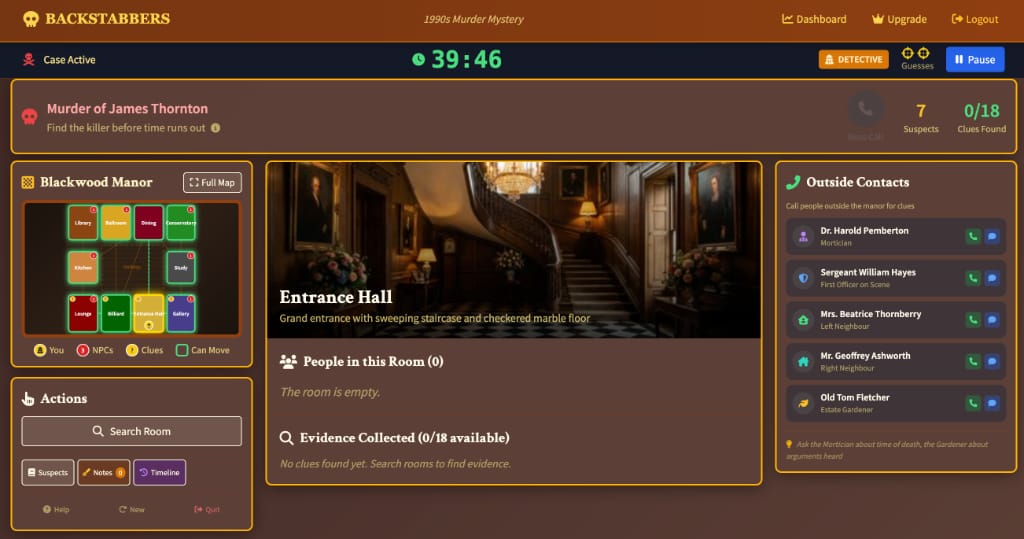
Interrogation games. The newest category, where you question characters rather than click through menus. This is what we build.
How to judge one quickly
Three checks, all doable in under a minute:
- Can you see the game before signing up? If not, the game is not the product.
- Is the boundary of the free part stated in plain words? Vagueness here is nearly always deliberate.
- Does it work on a phone browser without nagging you to install an app? A good sign about how the rest of it will treat you.
What the free tier here actually is
Since we are asking you to apply that test to other people, it is only fair to state ours precisely.
The Daily Case is free forever. No account, no email, no card. One case per day, the same case for every player in the world, taking around twelve minutes. It resets every day with a new case. You click the link and you are investigating; there is no wall in between.
If you make a free account, you additionally get three full-length investigations, which run from twenty-five to sixty minutes depending on the difficulty you pick. Beyond that, Premium is £6.99 a month or £59 a year, and you can see exactly what it includes on the pricing page. That is the whole arrangement.
Getting the most from twelve minutes
A short case rewards a different approach from a long one. There is no time to interview all eight suspects thoroughly, so do not try.
Read the case briefing properly before you speak to anyone, because it names the location and the circumstances, and that narrows who could plausibly have done it. Then pick three suspects and go deep rather than eight and go shallow. A suspect asked six questions will contradict themselves. A suspect asked one will not.
Search rooms with intent rather than sweeping them. When you find a piece of evidence that clashes with something you have been told, present it to that person. That is the mechanic that breaks a case open, and the one most new players forget they have.
Remember you must name both the murderer and the weapon. Working out who did it and then guessing the weapon is a good way to lose a case you had already solved.
Our beginner guide to deduction covers the method in more depth, and our guide to the wider genre is worth a look if you want something longer than a browser tab.
Twelve minutes. Eight suspects. No sign-up.